Videos

Jan. 16, 2026

Exercise Works—But Not How We Think

Exercise Works—But Not How We Think

Exercise helps people with pain—but strength gains alone rarely explain why. This editorial is a powerful reminder that how movement is delivered matters more than what’s loaded. Modern pain care means adapting movement to values, beliefs, and lived experience—follow for more clinician insights.

View more
Jan. 15, 2026

Stop Calling Arthritis “Wear and Tear”

Stop Calling Arthritis “Wear and Tear”

If you still frame osteoarthritis as “wear and tear,” it may be limiting your patients before rehab even begins. Modern evidence shows OA symptoms fluctuate, function can improve, and movement is part of the solution. Let’s change the narrative so patients can change their outcomes—follow for more modern pain care…

View more
Jan. 15, 2026

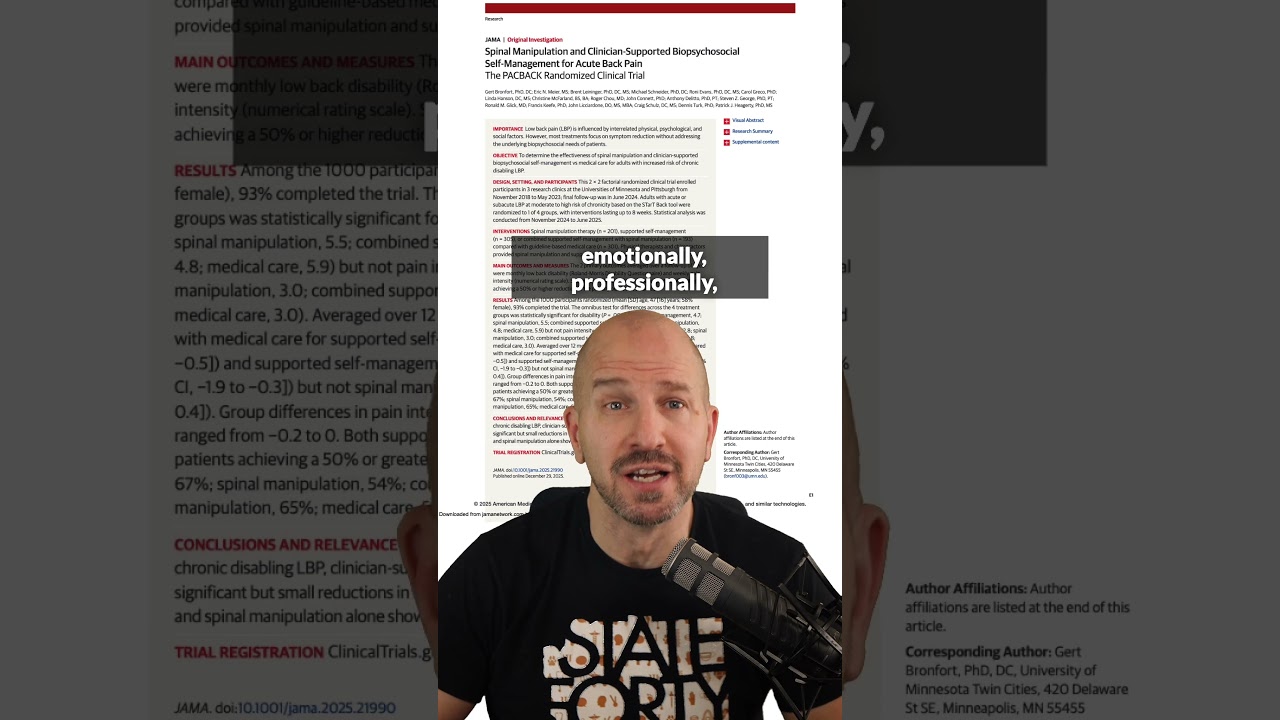
Self management vs manipulation

Self management vs manipulation

This study challenges an uncomfortable idea: spinal manipulation may be more clinician-biased than patient-driven. When patients are supported with biopsychosocial self-management, outcomes often hold without adding manual therapy. If that feels confronting, it might be worth asking why. Follow for modern pain care conversations.

View more
Jan. 14, 2026

Pain Education Paradox

Pain Education Paradox

We’ve never known more about pain—yet our toughest patients are still the toughest. This clip unpacks the Pain Education Paradox and why knowing pain science doesn’t automatically translate to better outcomes. Modern pain care isn’t about certainty—it’s about judgment in uncertainty. Follow for more clinician-level insight.

View more
Jan. 14, 2026

Clinician as Case Manager

Clinician as Case Manager

Chronic pain care needs guides, not just technicians. Physios may be uniquely positioned to act as case managers, helping patients navigate the key lifestyle, biological, and medical factors that shape pain. This is about coordination, honesty, and knowing when to involve the right supports. Follow for modern, clinician-led pain care.

View more
Jan. 13, 2026

Why Chronic Pain Patients Come to Doctors Not Psychologists

Why Chronic Pain Patients Come to Doctors Not Psychologists

People with pain don’t come to doctors by accident. They come because pain is a conscious, bodily signal linked to perceived tissue threat, and humans are remarkably intelligent about their own soma. Treating pain as primarily psychological misunderstands why people seek care in the first place. Follow for clearer, science-led…

View more
Jan. 13, 2026

Future of Pain Care - Biologics

Future of Pain Care  - Biologics

This idea makes many physios uncomfortable. If chronic pain behaves like autoimmune or autoinflammatory conditions, its future may be primarily biological, with rehab and psychosocial care as important supports, not cures. Obesity shows us what happens when the right biological lever is found. Follow for honest, forward-looking pain discussions.

View more
Jan. 12, 2026

Honest Limits of Psychological Interventions

Honest Limits of Psychological Interventions

Meta-analyses tell a sobering story. Psychological interventions can help with coping, disability, and self-efficacy, but they don’t reliably change pain intensity or trajectory. Chronic pain is often relapsing–remitting, and honesty about effect sizes matters for better care. Follow for grounded, evidence-informed pain discussions.

View more
Jan. 12, 2026

Modulation vs Cause Threshold Model

Modulation vs Cause   Threshold Model

Psychosocial stress can predict chronic pain, but prediction isn’t the same as reversal. The evidence shows psychological treatments have modest, modulatory effects once pain is established. Chronic pain may behave more like autoimmune conditions than we’re willing to admit. Follow for deeper, evidence-informed pain conversations.

View more
Jan. 11, 2026

Nothing Wrong With Your Body Is Misleading

Nothing Wrong With Your Body Is Misleading

We’ve learned a lot in the last two decades about pain, nociception, and neuroimmune interactions. Telling patients “nothing is wrong” ignores measurable changes in physiology. Let science humble us and improve how we explain pain. Follow for more clinician-focused insights.

View more
Jan. 11, 2026

Bottom Up Does Not Mean Tissue Damage

Bottom Up Does Not Mean Tissue Damage

We’ve inherited a 19th-century belief that pain must show up on imaging. But modern physiology tells a different story—altered nociception can drive chronic pain without tissue damage. If medicine accepts this for epilepsy and cardiac rhythm, why not pain? Follow @ModernPainPodcast chronicpain, paineducation, physiotherapy, painmanagement, nociception, pathophysiology, modernmedicine, clinicalreasoning, painneuroscience,…

View more
Jan. 11, 2026

Frameworks Matter More Than Techniques

Frameworks Matter More Than Techniques

New frameworks keep popping up in pain care—but are they really different? This clip breaks down Cognitive Muscular Therapy vs Cognitive Functional Therapy and why the lens matters more than the label. If your model helps patients understand and regulate their system, you’re on the right track—follow for more clinical…

View more
Jan. 11, 2026

Why Imaging Misses Chronic Pain Structural vs Physiologic Thinking Part 2

Why Imaging Misses Chronic Pain  Structural vs Physiologic Thinking Part 2

Get mentorship to apply modern whole person care to your practice - https://modernpaincare.com/course Part 2 goes from definitions to implications. Bottom-up pain does not mean “it’s in the tissues.” This episode is a recording of a live interview with pain researcher and clinician Asaf Weissman. If you haven’t watched Part…

View more
Jan. 4, 2026

Nociception vs Pain: Why Semantics Matter in Chronic Pain (Part 1)

Nociception vs Pain: Why Semantics Matter in Chronic Pain (Part 1)

Chronic pain care is stuck—and definitions may be the reason. In Part 1 of this two-part series, we reset how clinicians talk about nociception and pain. This episode is a recording of a live interview with pain researcher and clinician Asaf Weissman, whose work explores the relationship between nociception and…

View more
Dec. 30, 2025

Passive Care Isn’t the Cure

Passive Care Isn’t the Cure

Passive treatments can reduce pain—but only if they support active recovery. The real goal is empowerment, function, and progress—not repeating the same tool forever. Follow Modern Pain Care for clinician-first conversations that move patients forward.

View more
Dec. 29, 2025

When Procedures Help—and When They Harm

When Procedures Help—and When They Harm

Not every procedure helps—and the wrong one can make things worse. Clear indications, shared decision-making, and a plan beyond the procedure matter more than the intervention itself. Follow Modern Pain Care for thoughtful, evidence-informed clinical conversations.

View more
Dec. 28, 2025

Regenerative MSK Why We’re Not There Yet

Regenerative MSK  Why We’re Not There Yet

Regenerative medicine will come to MSK—but not the way it’s being sold right now. True breakthroughs take decades, rigorous lab engineering, and real efficacy data. Follow Modern Pain Care for evidence-informed conversations clinicians need.

View more
Dec. 28, 2025

Chronic Back Pain? What ACTUALLY Helps Long-Term Recovery

Chronic Back Pain? What ACTUALLY Helps Long-Term Recovery

Join our next cohort of Pain Practice OS - https://modernpaincare.com/painprogram Most back pain improves – but how we guide recovery makes all the difference. In this part 2 conversation with Dr. Jim Eubanks, we dig into: First-line care for acute low back pain • Why rest is often the worst…

View more
Dec. 17, 2025

Nociception and Pain | Live Podcast with Asaf Weisman

Nociception and Pain | Live Podcast with Asaf Weisman

In this live episode, I’ll be joined by Asaf Weisman, a researcher whose work has challenged prevailing assumptions in contemporary pain science and reignited important discussion about the role of nociception, biology, and definition in our understanding of pain. Asaf has raised thoughtful critiques of concepts such as nociplastic pain…

View more
Dec. 13, 2025

Why Back Pain Myths Keep Patients Stuck (And What to Say Instead)

Why Back Pain Myths Keep Patients Stuck (And What to Say Instead)

In this episode, Dr. Jim Eubanks, physiatrist and spine specialist, breaks down the most harmful back pain myths patients encounter online-and what clinicians can say instead.** If you've ever struggled to help a patient move past catastrophic thinking or scary MRI language, this conversation will give you the tools to…

View more
Dec. 10, 2025

Are We Messaging Musculoskeletal Care All Wrong

Are We Messaging Musculoskeletal Care All Wrong

The debate around “manual therapy” is bigger than semantics—it’s about history, identity, and how we communicate our value. This clip breaks down why the term still shapes clinician understanding, even as our models evolve. Follow for more conversations that help clinicians think critically and practice confidently.

View more
Dec. 9, 2025

Pain Care Will Not Change from a Conference Stage

Pain Care Will Not Change from a Conference Stage

We keep trying to change pain care from conference stages—but the patients who need us are scrolling on TikTok and YouTube. Clinicians can share accurate, hopeful messages without compromising integrity. If you want to build impact and reach the people searching for their 5th or 6th provider, follow for more…

View more
Dec. 9, 2025

Are We Still “Prisoners” of Manual Therapy #manualtherapy #physicaltherapy #physiotherapy

Are We Still “Prisoners” of Manual Therapy #manualtherapy #physicaltherapy #physiotherapy

Manual therapy has shaped our roots—but should it still shape our identity? In this clip, we dig into the tension between historical influence, public perception, and what fellowship training truly teaches: OMPT is far more than one technique. Follow for more clinician-focused insights that challenge assumptions and sharpen reasoning.

View more
Dec. 8, 2025

Research Means Nothing Without Impact

Research Means Nothing Without Impact

Clinicians know pain is complex—but our patients want clear, actionable steps, not esoteric theory. This clip explains how a simple spreadsheet evolved into Pain Coach, giving clinicians a practical way to support behavior change and lifestyle factors. Follow for more tools that turn BPS ideas into real-world clinical action.

View more