


HLH Nearly Killed Me—Here’s What It Taught Me About Care
🎙️ What happens when a clinician becomes the patient—and almost doesn’t survive?
💥 HLH. ICU. Life support. Then… powerlifting again.


🎙️ What happens when a clinician becomes the patient—and almost doesn’t survive?
💥 HLH. ICU. Life support. Then… powerlifting again.
In this powerful episode, strength coach and physio Jared Maynard shares his shocking journey through a life-threatening diagnosis of HLH, his fight to stay alive, and what he learned about healthcare, humanity, and healing.
You’ll learn:
- What HLH is—and how it nearly ended Jared’s life
- The deep clinical lessons from losing strength, speech, and independence
- How small human moments in care created lasting impact
- What it’s like to rebuild your life, body, and mindset after ICU
- How Jared’s story reshaped his clinical work and coaching
- Why “being human” matters more than “having the answer”
Whether you’re burned out, feeling disconnected from your work, or want to show up better for patients—this story will move you.
👇 Subscribe for more clinician-to-clinician conversations.
🧠 Join the Modern Pain Pro community.
🎓 Explore Pain Practice OS and start applying modern principles.
*********************************************************************
📸 - Follow us on Instagram - https://www.instagram.com/modernpaincare/
🐦 - Follow us on Twitter - https://www.twitter.com/modernpaincare/
🎙️ - Listen to our Podcast - https://www.modernpaincare.com
____________________________________
Modern Pain Care is a company dedicated to spreading evidence-based and person-centered information about pain, prevention, and overall fitness and wellness
Jared Maynard: [00:00:00] So they gave the last treatment and I was still actively getting worse to the point that my hematologist told my parents who were on shift at the hospital, they, and my wife really traded on and off. They told my parents that there's nothing else that they could do and that. They should start getting ready to talk about palliative care and to say goodbye that week.
Mark Kargela: What happens when the clinician becomes the one in the hospital bed? In this episode, I'm joined by, in this episode I'm joined by Jared Maynard, physio coach and strength athlete for a story unlike anything we've shared before. Jared walks us through a shocking health crisis, a diagnosis of HLH that landed him in the ICU on life support, and unsure if he'd ever returned to his family or himself. We talk about what it means to lose your strength, your independence, and your voice, and the deep clinical lessons Jared learned in that vulnerable role.
As a patient, you'll hear how small acts of humanity shaped his recovery, how he found purpose again, and how his entire experience changed his career. If you ever wondered how to show up [00:01:00] for patients when you don't have the answers, this conversation will move and challenge you.
Let's get into it.
Announcer: This is the Modern Pain Podcast with Mark Kargela.
Mark Kargela: I'd love if you could talk about, ' cause you're somebody who's been in the lived experience and this is why I really thought it would be a great conversation to have.
As far as somebody who really had to take the role of the patient and really had some challenges with their health and had to engage in the healthcare system, I, and we haven't even talked about it yet. I'm curious to hear what the good and the bad is. But before we get into that, can you kinda let people know some of the challenging situation that you've faced and where it put you and then we'll get into more of the kind of challenges the healthcare system posed as part of it.
Jared Maynard: A hundred percent. The story really starts in almost exactly a year ago in 2023 maybe a little bit more than a year ago. It was after New Year's, and I started to feel sick. Didn't think much of it. It's the time of year that everybody gets sick. Much as we're talking now. The thing that started to tip me off that this was different was a week later I was starting to get worse and while [00:02:00] my wife and my daughters had the same sort of illness or bug. They were all better at that point. So thus began this two or three week stretch where I started to go to my started to notice more symptoms beyond the usual, fatigue and malaise. My, I had insomnia for the first time in my life, which was odd. My lymph nodes started to swell, had some sinus pressure, so I went to my nurse practitioner, 'cause my family doctor was out at the time. We figured sinus infection. Got the antibiotics, got a nasal spray, off you go. Running the course of antibiotic antibiotics, not doing the trick, and I'm getting worse as we go. So the insomnia's worse. My lymph nodes are swelling and you know those topographical maps that you run your fingers along?
Mountain ranges? That's what my neck and my shoulders started to feel like. So we knew something was like significantly wrong because this was territory I'd never touched before. So we live out in the sticks. Horses and buggies on the road. So we went to a small hospital that was closer to us and I went into the er, got diagnosed with [00:03:00] mononucleosis, which brought back instantly memories of high school and being teased.
Jared's got mono. I never had mono. My friends were just assholes sometimes. But it was strange because I'd never had mono nor had my wife. We'd been married for a good chunk of time. No idea how I got it, but apparently I had it. So got prescribed some sleeping medication to handle the insomnia. And then back home I go, it was three days after that, around five in the morning or so, another night where I hadn't slept. And I'm at the kitchen table and my wife is looking at me and she goes, you are yellow. And we both think, oh. We know something bad is going on. Don't know why my liver's failing, but something's happening. So that was the morning that we called in some reinforcements to watch. My daughters happened to be the day before my twin daughter's fifth birthday. And we had to drive further to go into a larger hospital that had more facilities 'cause we needed to figure out what was going on. And quick backstory on me. Like I said, I've been involved in strength and conditioning and training for 18 plus years. I grew up as a fat kid with [00:04:00] no self-confidence because I got picked on constantly by the kids at school who always reminded me that I was fat and always reminded me that I wasn't wanted on the teams for recess in a gym class because I was picked either last or second last. Parents tried to get me into sports when they saw that I was recoiling from that constant rejection by just hiding in the basement and watching tv. I figured I didn't articulate it this way, but if I was gonna be rejected over and over, I was just not going to be around the people who kept rejecting me and the TV couldn't reject me. So my parents, again, seeing this, they wanted to try to help me out. I tried sport after sport. Nothing stuck until kung fu. It could have been because I grew up watching Mighty Morphin Power Rangers. But that was the thing that one gave me agency where if you go from this place of being rejected and feeling vulnerable and weak, and then someone gives you the ability to protect yourself and to carry yourself differently, life changing. It also started to. Teach me integrity and discipline and teamwork. And I was the [00:05:00] first exposure to an environment where people were supportive and welcoming of me as opposed to reminding me that I wasn't welcome. That was important for me because then that gave me more confidence to go out and try new things, which after a family movie night and watching the movie, remember The Titans, which is a phenomenal movie. And I should probably watch again after we talk. I wanted to go play. For high school football. So I went out, played for three seasons, and between my junior and senior year, the coaches only had one rule at the end of the junior school year and before senior summer camp, they did fitness testing and it was sprints, it was pull-ups, it was dips, it was a bunch of other stuff. And their only rule was if you come back for summer camp and you're better, you get to play. They didn't care about how much it could be one pull up. For me it was two. 'cause I got one pull up at the beginning and I got three at the retesting, which was great. But that's what introduced me to lifting weights in my parents' basement to get better for football. At the end of the senior season we didn't go as far as we thought we would. We got knocked out [00:06:00] in the quarter finals and now I needed something to keep me busy for two hours a day, five days a week. 'cause we didn't have practice. So the gym was there. It's relevant because that was another taste, a different taste of confidence that really started with kung fu.
It continued with football and now it's in the gym. So I continued with that through my undergrad, all through PT school, different iterations of training for aesthetics, and then trying to compete in natural bodybuilding and then power lifting, which I still do and I still coach. So that. Snaps us back to that morning after my wife realizes that I'm yellow and we go to the hospital. Because at this point I've got many years under my belt where I'm used to being strong, trusting my body being able to do some pretty cool things. And that morning when I got out of the van the, entrance to the ER was maybe 20, 30 feet away, give or take. I really didn't know if I was gonna be able to make it all the way to the doors or if my wife would have to go and get a wheelchair because I was that [00:07:00] dizzy.
My heart was racing outta my chest and at the triage station, my heart rate was clocking around 200 and my blood pressure was spiked. And I told the next nurse who did registration, I'm gonna pass out here. And I pretty well do I get admitted to the er and then that's where my memory starts to go really spotty. ' cause over the next six days my condition deteriorates quite quickly and I start to become delirious. I'm on supplemental O2. There's this constant stream of doctors', specialists, nurses in and out of the room, beginning to try to figure out what the hell is going on. My vision is going, I have a preexisting genetic progressive eye disease. But this was like someone took a dimmer switch for life and turned it down to 50%. My wife told me that later. The scariest moment of her life so far has been seeing me in the er, her big strong husband, about six feet. I was 194 pounds at the time, so weak. That I couldn't [00:08:00] get up out of bed to go to the bathroom and in so much pain, and we had no guarantees about w if I was gonna be okay, how long we were gonna be here. My wife now starts to think about how she's gonna break this to our daughters and explain if daddy's coming home and when and even what the hell is going on here. So six days later. I'm still in this tailspin, and that's the night that I get put on life support as a product of all of the tests and blood draws and images over that six day spin.
We finally landed on a diagnosis of something called HLH, which is an acronym or initialism for hemo, phagocytic Lympho histiocytosis. It's not a true autoimmune disease, although that's how it was presented to me in the hospital at the time. It's a hyper inflammatory syndrome. It's got two types of primary or secondary. Primary is genetic and it shows up usually in newborns. Secondary or adult onset is secondary to either an infection a cancer, or a different autoimmune disease. In any [00:09:00] case. The immune system gets so ramped up and it leads to a cytokine storm and the system attacks healthy cells, especially red blood cells, and the stats range in mortality rate from 50% to 75%, so at best at a 50% shot of making it out of that ICU. And this is where my memory is a black box and I had to be filled in after the fact supplemented by many pictures and videos, which I still have. But the treatment is brutal as the disease process itself is brutal too. Placed on life support. I was on a ventilator, I was on dialysis. I had IVs out the wazoo and. The team of doctors and healthcare specialists were fantastic. My hematologist led the charge with a number of other specialists between them, the nursing staff and the pharmacist. They made day by day and hour by hour calls to decide how much of the necessary treatment they could give me. [00:10:00] Because it's the irony of this sort of thing that you need chemotherapy to as part of the treatment protocol. But being as weak and as ravage as I was with the disease process, I couldn't handle the full dose. So five weeks in total is what I spent on life support. And those first two or three were the gnarliest. Because through the administration of the chemo and the corticosteroids and the monoclonal antibodies and trying to fend off all the hospital acquired illnesses of which I. Got a few. And despite the staff trying to do their best to both treat the illness and avoid pressure ulcers, which didn't stop me from getting pressure ulcers and all of these things all of my vitals were getting worse and we were down to the last treatment. It was a monoclonal antibody because all of the other things that we were doing according to the treatment protocols and consulting with specialists at other hospital centers, it just wasn't cutting it. So they gave the last treatment and I was still actively getting worse to the point that my hematologist told my parents who were on shift [00:11:00] at the hospital, they, and my wife really traded on and off. They told my parents that there's nothing else that they could do and that. They should start getting ready to talk about palliative care and to say goodbye that week. Spoiler alert, I'm obviously still here. And I can only tell you that at that point in time, even after my medical team was starting to make arrangements because they were seeing more decline. When there shouldn't be. There was a lot of prayer going on in lots of places, and I started to come out of my nose dive when I shouldn't have. And some of the doctors and nurses who were there with me through the whole ride, once I regained consciousness and started to get my bearings, they gave me the nickname Miracle Man. Now coming out of. Off of life support and regaining consciousness in the ICU. By no means, means that I woke up and suddenly was good and everybody clapped. When I woke up, I remember as I started to understand where I was and started to try to move, it felt like I [00:12:00] was waking up in somebody else's body where I went in 194 pounds or so. Because I couldn't receive much nutrition, though they tried through the NG tube and all of this, the inflammation because of the HLH, made it so I couldn't absorb it. So all of that muscle tissue that I built over the years of training in the gym for bodybuilding, then for power lifting, that started with me gaining the confidence to be in this in an environment to push myself with kung fu and football and in the gym ended up being. Fuel that my body used to buy me time through the ICU and the journey from that point on really began with a single decision that I at once had to make once and then make on a repeated basis afterwards, because nobody could tell me what the road ahead was gonna look like. And like we talked about before we started recording it was a special kind of head trip to be a physical therapist and to be the person who remembered learning in school and being on rotation. [00:13:00] How you come in and do chest physical therapy and you do tracheal suctioning and you teach somebody to ambulate and you use a Hoyer lift to get them into the chair. Now I'm the one who needs that and. It was a blessing and a curse because in general, as I was part of these conversations and I understood more of where I was and what was going on, it was helpful because I understood who these people were. I understood what was going on and what needed to happen, and at the same time, that made it worse because I understood how dire this thing was and how far I had fallen. Not only could I not move, I couldn't get up if my life depended on it to go to the bathroom the actual force production necessary to sit up in bed. I did not have I also couldn't speak because of the trach. They had to move the vent from initial position to the trach afterwards because of how long it was in. I couldn't. Yeah, I couldn't swallow either just because of the atrophy of all the esophageal muscles. I had a, an intention tremor every time that I tried to write. So if you can imagine, in all of the [00:14:00] ways, both as a clinician, as a coach, as a husband, and as a father I'm used to, and I've needed to be a, good communicator.
I've needed to be the one who's able to get my thoughts across and help pe whoop, sorry, help people out. And now I can't write down a note to my wife to tell her I don't want her to leave and I can't say that I love her or ask for something, and I'm completely dependent on. On everybody else, for all of the most humbling basic tasks that I haven't had to rely on anybody for since I was three or four. So the decision that I had to make was whether or not I was going to fight and work to try to make it back home to my family. And. I decided that yes, I was going to because I wasn't dead yet. And it was simple in that sense for me. If I wasn't dead, then I wasn't done. And there's work that I was gonna do. I was gonna do everything that I could, and at the same time, being very real I've known. Grief and sorrow before, especially as I got my diagnosis about my eye condition, which I got around. I got [00:15:00] the formal diagnosis around 19 or 20, but we knew something was wrong around 17 or so. When all of my friends were getting their driver's licenses, some were getting cars and I was being told I can't drive because it's not safe. And this whole vision that I had for myself and my life was now suddenly. Shattered and changed. So I was acquainted with grief that way, but the grief here was, I'm not sure actually if it was more profound, but it was more, not oppressive is a different word. The grief before, with my eye condition, I could shove into a box. This one was every waking moment. Which is why I needed to keep making that decision to keep going every day, which doesn't mean I got up every day. There were some days in the hospital where I just, I didn't have it, and I was angry at the world at God. Why this, why me? And didn't get up for my pt, didn't go for my walks, didn't do my bed exercises. But the next day I did. And. That was the process for weeks and weeks of chewing ice chips and swallowing them to retrain my [00:16:00] esophageal muscles so I could be safe to eat and drink. Mark, when I tell you that I would've considered pretty serious crimes if I could just drink a cup of ginger. A, that. That was part of it. It was learning to stand and walk with the other PTs and rehab assistants who again. I was the guy who was working alongside them not terribly long ago, but now I'm the one who needs their help. But it was taking those walks and then with the platform walker and then with the four wheeled walker and then the quad cane fine with a single point cane. And that process continued at h at home. And it took a year. Really, it took longer than a year to feel like I was back or normal, but just over a year after leaving the hospital on May 25th, 2024, I returned to my first powerlifting competition after all of this, and at a perfect day, went nine for nine, that lifted a lifetime PR of 501, and then did it again. Three months later with another lifetime PR of 5 0 7. And [00:17:00] it shouldn't be a surprise to anybody, who listens to this, that this whole experience has changed me certainly physically. And there's, there are scars, both physical and metaphorical that I still have and that I don't think will ever go away. So I'm changed that way and. Part of that change, I believe has been for the better if for no other reason than I've chosen to do everything that I can to make it that way in the work that I do, which is, especially with coaches and clinicians right now, and with what I'm focused on as I move forward, especially with public speaking. So yeah, when the provider becomes the one provided for that's been the arc.
Mark Kargela: An amazing story. I mean that, that is a journey and a half and to go from the healthcare provider to the, one provided for before we get in, I'm wondering like, how does your perspective people have these, I've seen some good friends go through some really challenging health, scares similar and their perspective changed a lot afterwards.
I'm wondering like how you feel, like your perspective on. Things in life and what's [00:18:00] important, maybe what's not important have had shifted as a result of that.
Jared Maynard: I'll start by saying it's actually, I think it's scary how easily I can still get wrapped up in the small details day to day. And a mentor of mine told me this while I was still in the thick of it. Dr. Frank Benedetto, who's the founder of the Honey Badger Project. He, in one of our earlier conversations had said, for the people that he's known in his life who've gone through life altering and life threatening things, it's remarkable how quickly the minutiae and the mundane stuff become important again. And you think it wouldn't happen or at least you might. So it's a daily battle that I've got. But when I bring my attention back to it and I realize, oh, I'm worried about the reach that my post did or didn't get on social media, I'm worried about this other thing. I'm like, dude, you almost died. You're probably gonna be fine. That single post probably doesn't count for a whole hell of a lot in the long run. But the positive ways that it's changed priorities for me is one, it's really. It's forced me to put guardrails up, [00:19:00] especially when it comes to my work. I'd imagine that many of the people listening here, especially as coaches or clinicians in particular, partially because of the demands of the system, whether you're working in outpatient or in the hospital setting or in other, settings. And partially because I think that's it draws people who are willing to work and are hard workers, they need to get in into competitive programs. I have always had the tendency to just work myself into the ground if left to my own devices. And prior to all this happening, I was healthy. And part of the workup was, looking into my personal health history and my family health history, and I had no predisposing factors. We checked, we ran the genetic sequencing and there's nothing that would predispose me to this. So my hematologist told me like, this is a really unlucky fluke. And as I recovered, I physically could physically and mentally couldn't keep up the same sort of work output that I had previously, which meant that I had to learn to adapt. I had to learn to how to adapt in work and in general in my life. And while I'm back up to, I would say I'm back up to my work [00:20:00] capacity, similar to what it was before all this went down, I actively. Keep up these boundaries in my schedule and I have better communication with my wife because I very nearly didn't make it back to them. And for anybody who's listening who's okay, that's intense hard, it makes a lot of sense. I haven't been through that. Totally fair. And I hope, I sincerely hope that you and nobody else has to go through something like that. Still, you might remember Mark, when Stoic philosophy really made its foray into the rehab world and still sticks around. I have a tattoo of Memento Maori on my forearm which I got after this HLH experience, which for anybody not familiar is Latin for the phrase, remember, you must die, which is true for each one of us. The reality is we have no idea when that's going to be. We have no idea when that's gonna be for our partner or for our kids, or for the, our friends, the people that we really care about. On the ground example for me and my kids, if anybody else has 'em, is my daughter's called my wife up late last [00:21:00] night for an extra hug and to be ret tucked into bed. On one hand, it's like it's late go to sleep. On the other hand, it was the moment of clarity for me of there are only so many more requests for hugs and being tucked in that we're going to get, so that's been the biggest change for me.
After all of this is just a greater effort to remind myself on the day-to-day basis of. Yeah, there are these things that feel big in the here and now, and maybe they matter for the month, if it's not going to matter in three years or five years, not to say it has no importance, but you're probably gonna be okay and it's probably not worthy of all of the stress that's attached to it.
Mark Kargela: Good perspective to gain from that as far as being a patient coming in as a clinician, right? And somebody who's usually the one who's. Giving the advice and directing things and, but you had some knowledge, obviously, like you said, as you were telling your story, you knew as you were waking up that you were in a pretty rough situation with what the rehab was entailing and all these different [00:22:00] things.
I'm wondering though, if you can reflect as a patient in your journey in the healthcare system, and maybe yours was wonderful. I, it sounds like you had a great healthcare team. I'm just, as you've had that patient perspective, how has it changed you as a clinician as far as how you see somebody who's going through, and maybe it doesn't have to be something as horrifically challenging as what you went through, but I'm wondering how it's changed your perspective as a clinician.
Not, and also working with, like you said, coaches and physios and clinicians who are maybe dealing with some tough stuff. I'm wondering how that's impacted your work.
Jared Maynard: the humanity has just has never been on fuller display for me, and I haven't appreciated the importance as much as I do now. What I mean is. Through the entire experience, I was amazingly blessed to have, by and large some incredible people at all levels. Both the physicians and nurses, ot, pt, SLP, even the porters, the techs who did imaging. By and large, these people were incredible. The moments that stand out the most [00:23:00] for me. Both in the hospital and then also in, in all of the follow-up appointments. And this even bleeds over into my experiences with ophthalmologists as it relates to my eye condition. There were days where I felt so isolated and so fearful of whether this was ever going to feel I was ever gonna feel better, was I ever going to be okay again? Just absolutely swamped by the grief of both the person that I was physically in terms of my life achievements. And now I'm grappling with who am I now? Which is really the level of struggle that this was for me. And just overwhelmed by all of these emotions and there were small moments where. A nurse took the time at whatever hour it was in the morning in the ICU to ask, Hey, what kind of music do you wanna listen to? And I couldn't tell her because again, I couldn't speak after the trach. So on her gloved hand, I spelled out City and Color and John Mayer and we didn't get it the first time.
It took about seven or eight tries. But her [00:24:00] willingness to be there and take a few minutes, which again, we're talking about the ICU. Where there's always something to do. She took the time to check in on me and to add one small thing that I don't know if she remembers, but I'll never forget that. Or the time that I was in the ICUB.
They had two levels. ICUA was the most intensive. ICUB was less. It was an ICUB starting to recover. And my physician, she took about five to 10 minutes. I don't actually remember how long it was because I was just sobbing. I was so overwhelmed with all of those emotions, and she just stood by my bedside and held my hand and just let me cry, and she was there. I could keep going with these small. Memories of even other nurses who were just, they were cleaning me. They were giving me my, my, my washup for the day. And we were ribbing each other about who the better boy band was between NSYNC and Backstreet Boys, where they had asked if I had seen the last of us, the series, and just that humanity, that [00:25:00] dignity and that intent to make me feel included and not alone and cared for. Absolutely changed my world. On the flip side I remember a few moments in particular one of them was an eye appointment with an ophthalmologist as my vision, excuse me, degraded after making it home from HLH and. Again, the situation where I didn't know what was going on. My condition isn't supposed to get worse until middle age. At the time I was 33 yeah, 33. It's what's going on? And I'm nervous because this is affecting everything in my life with a primary sense. And that particular ophthalmologist was very detached. He was good at what he did, but he was sterile. And I was. On the inside, I was dying for anything. Just tell me that you're, you see me, make me feel a little better.
You don't have to tell me everything's gonna be okay if everything's not gonna be okay, but just give me two seconds of you being a human. And it didn't happen. Again, by and large, very grateful for the people that I've interacted with. The majority have been [00:26:00] phenomenal. And it's taught me that for me as a coach and as a clinician. Whatever the other person that I'm interacting with has gone through or is going through, whether it's an injury, chronic or acute pain, maybe they're the ones who are dealing with feeling overwhelmed and they look at pictures of themselves from years ago and they felt strong. They felt good then and they don't now. Whatever it is, those are all real situations though. Just having that humanity be at the fore builds the trust that is necessary for any sort of professional relationship. Because if that person trusts me, to see them, to hear them, to listen to them and understand what they want and what they need, and we have that mutual trust to explore the process beyond that, they may not be somebody that I directly can help, but it's a whole hell of a lot more likely that we're both gonna understand what they need and what that next step needs to look like. So that's been the biggest thing I think.
Mark Kargela: The humanity piece is one of those things that we've had to battle, cry on, bringing the humanity back to healthcare as you've had some amazing experiences where. [00:27:00] Was put, front and center and obviously had an impact on you as you're reflecting on it. And I just, the frustrating thing, I'm sure you've shared the frustrations of a healthcare system and like your ophthalmologist and I think as humans, some of us have more difficulties, being vulnerable or just, not and especially some of our authoritative figures in healthcare.
There's some p physios I've worked with, but I do think some physicians sometimes have to feel like they. Have the answers. And when they don't, it's hard to just come down to, I don't have the fix, I don't have the thing that's gonna, solve this for you to where we reverse it, where you're looking for just someone to hear and see you as someone who's suffering and really struggling with the journey that you're having with your eye condition.
Something I think we can all learn as clinicians. 'cause I think would you agree? Like with a lot of the patients we see in pain, it's not something that maybe we're gonna be able to wipe clean to zero outta 10 from here on out. But having that skill to sit with somebody, I don't know. Have you seen that in your care where you can just sit and show that humanity to somebody and how valuable?
'cause I think there's this misnomer for [00:28:00] clinicians that think that, especially young clinicians where I have to have the answer. I have to have the why. The what? The fix. That's gonna get this person there. And when I don't, I'm inferior and I can't show that in front of a patient. I when you can recognize those situations and just look somebody in the eye and say, this sucks.
I don't know a hundred percent of what the best thing is, but here's our options. Here's how we can move forward.
What would you value? Where do you see that as far as how you're practice and where you see just general practice existing?
Jared Maynard: so many thoughts. One is I remember being that clinician for a long time, especially as a new grad who, okay, I'm newly minted. I got my license, I got, miss Susan coming in on Monday, she's in pain. She's coming to me because she expects me to have the answer. I better have the answer. So yes I've seen that.
I've felt that. And I think for one, it comes from, I think we can say it, it comes from a good place because if you didn't feel that pressure, you wouldn't care. And that's concerning, especially in a healthcare field. [00:29:00] So I think multiple things are true and need to be true here for us to do the best that we can. To your earlier point for both the. Individual personality level layered on top of our professional role and designation and authority layered on top of the individual client situation and like the urgency and whatever other motions are permeating it, all of these can stack and can make it really charged and really hard to navigate. So I'm gonna speak validity to all of those things, and I don't believe that. Everybody listening here needs to take the tack that I personally take. I'm not proposing that. I'm a very again, my mentor told me this recently. He's I'm a very feely person. He said that of me. And it's true. There's probably a reason why a majority of my clients are female. I talked this through with chat GBT the other day. 'cause I wanted to just see is this coincidence? So there might be a factor. Not saying everybody needs to be that because everybody's got. Different experiences, different personality types. I do think a through line though is that because our work [00:30:00] is with people there needs to be focus on maintaining human dignity and connection and trying to build as much trust as we can slash as reasonable. Actually I'll walk that back just as much as we can, and I don't think that is synonymous with having the answers. I think that you, mark, I, Jared, anybody else listening? We are fallible human beings, which, yes, of course we should. And we do strive to be as good as we can and to do right by the people that we work with, and we try to be better and learn, and striving is true at the same time, it's true that we are not going to have all the answers. Until you or I figure out the secret for omniscience, in which case I'm gonna expect that DM when you figure it out and I'll do the same. I got riled up. What was the question again?
Mark Kargela: I was getting tailed off there myself as far as thinking ahead of things a little bit. I think just that whole perspective as a student and the just being human and being okay to be human and not having that omniscient, I know all presence in the clinic. How [00:31:00] does I, and I, let's bring that to where you are right now with your work.
'cause I think you see some of the. Difficulties that clinicians and coaches face right. With some of their challenges in their career. And we have healthcare systems and a lot of things that bring some unique challenges too, but I'm guessing that, that humanity still serves you well when you're serving them.
Jared Maynard: A hundred percent. I'm glad you brought that up because one other point that I think may serve some people to think about whether it's in the clinical setting or for me, since I'm working full-time in my business online, it comes up here, you said it before, where whether it's chronic pain or a condition or in some cases it's a progressive disease. I've got one from my eyes. There are many others that exist. There's something that's not going away quickly or not going away at all. I think of friends of mine who are neuro PTs and working with folks with Parkinson's or ALS or ms. These are difficult things. They're not the only ones that are difficult, but they come to mind and I've got some skin in the game and [00:32:00] experiences here where. When you're working, when you're talking to somebody, when you're with somebody who's dealing with something, they're in it and you don't know how long they're gonna be in it. Maybe they're hoping against hope that you're gonna have some piece of good news, this shred of, of a chance that they can have a different path than what they're suspecting they might already be on or need to be on. My belief is that. In those moments, even if you can't move heaven and earth to change somebody's situation, or when they finish seeing you that day, or when you log off the computer, they're still gonna be in pain. They're still gonna have the condition. I still believe that it counts for something to be there and be as fully present as you can be. Which means listening. It means asking questions. I do think that means honesty. Sometimes that's honesty, that broaches difficult topics. It's saying, you know what? I don't have the answer for that for you right now. And it might also be following that up by saying, here's what I'd like to do. If you're open to it, I want to go check in on that question [00:33:00] for you. Or I have a colleague here, or I know somebody who might be able to help you. I think that even if you can't erase all of the hardship that somebody is going through, you just showing that you're acting in good faith and doing what you can to help them. My experience has been that people appreciate it and they notice it, and it might seem like small potatoes because you walk away thinking like, damnit I wish I could do more. I still have those people in my mind. I gave, I helped to present at a clinical athlete event in Austin, Texas at the end of 2024. And part of what I was speaking on was my section was on pain, neuroscience education or just pain science in general. And one of the things that I'd said was, you remember the people that you couldn't help or couldn't help in the way that you wish you could. And I think the longer that. Any of us are in this position, in whatever capacity that we work, we probably have those people that we think about from time to time. And, they may stick with you for a good long time. And my encouragement and belief is that all you can do [00:34:00] is all you can do. And that's not a nihilistic. Why try, if anything, that's just a it's an encouragement. To just lean in and give what you've got, and again, be a human. You don't have to be perfect. Just do your best. As I tell my daughters.
Mark Kargela: Good advice to live by. For sure. For sure. Jared, I want to respect your time and we're gonna, we'll line the plane with where are, where can folks who want to maybe get to know your work a little bit? You're obviously on social media doing some good things. You're serving clinicians and coaches and you're doing some great stuff and also a good speaker just from listening to you in the podcast.
And you that obviously has come through clearly tonight, so I'd love if you could just share where people can get in touch or get to see your work.
Jared Maynard: Totally. Yeah, I'm in a few places. Instagram and TikTok, Instagram would be the easiest, but it's the same handle in both places. Jared, J-A-R-E-D, dot Unbreakable. If email is your jam, you can shoot me an email. It's jared@unbreakablestrength.net. And if anything that Mark and I have been talking about tonight. Resonates. You want, you're going through [00:35:00] something or you know somebody else's going through something. Maybe you want to geek out about Lord of the Rings in Star Wars. Shoot me a message. I'm an open book. I'd love to hear from you. See where you're at, and if I can help, would love to do that too, especially if you're coach or clinician.
Mark Kargela: Yeah, great resource and somebody who definitely is worth having a conversation with. I've enjoyed our conversation tonight immensely my friend. And thank you for your time and thank you for the great work you're doing.
Jared Maynard: Thank you, mark. I appreciate the time. This was an awesome conversation. And likewise thank you for doing what you're doing for our profession and our space.
Mark Kargela: I appreciate that, man. For those of you listening, we'd love if you could subscribe the podcast and if you know somebody who could benefit from hearing this story and some of the inspirational stuff that Jared has shared today to make sure you share the episode. If you're watching on YouTube, if you could subscribe, we would love that.
But we were gonna, we'll leave it there this week. We'll be all of a great week. We will talk to you next week.
[00:36:00]
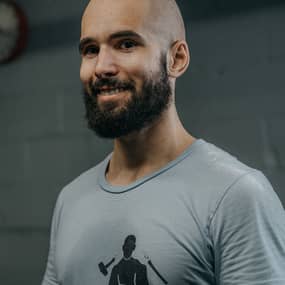
Physical Therapist, Strength Coach, Powerlifter, Speaker, Owner of Unbreakable Strength
Jared Maynard is a Physical Therapist, strength coach, powerlifter, ClinicalAthlete provider, business owner and speaker who believes that “you’re not done yet.”
In 2023, after nearly two decades of lifting and a decade of coaching, Jared was diagnosed with HLH—a rare, often fatal immune condition that landed him in the ICU on life support. His body broke down, the last treatment failed and the doctors prepared his family for the end. But his life was saved by two things: a miraculous recovery, and the muscle he built through the years spent in the gym.
He woke up in the ICU as skin and bones – 40 pounds lighter, and unable to walk, talk or breathe on his own. Just over 1 year later, he returned to powerlifting to deadlift a lifetime PR – then did it again three months later.
Now, despite being legally blind and navigating progressive vision loss, Jared’s mission is clearer than ever: to give you the skills, support and hope to rebuild after everything falls apart.
Through his business, Unbreakable Strength, he’s the coach who helps coaches and clinicians get out of pain, train hard, and build strength & confidence. He speaks on podcasts and stages as living proof of what’s possible when you believe that “you’re not done yet.